- About
- Academics
- Admissions & Aid
- Life
- Centers, Research & AI
- Centers
- Andrew Young Center for Global Leadership
- Martin Luther King Jr. Collection
- Center for Black Entrepreneurs
- Center for Broadening Participation in Computing
- Center for Excellence in Education
- Center for Sustainability
- Ida B Wells Society
- Innovation and Entrepreneurship Center
- Morehouse Writing Center
- Institutes
- Research at Morehouse
- AI at Morehouse
- Centers
- News & Events
- Open House
About More Lab
 The Materials/Optics Research & Engineering (MORE) Lab at Morehouse College is an interdisciplinary research group focused on advancing the science and engineering of light–matter interactions. The lab investigates fundamental and applied problems in photonics, quantum optics, ultrafast science, and engineered optical materials, with an emphasis on how structured materials can manipulate electromagnetic waves in new and useful ways.
Research in the MORE Lab combines theoretical modeling, computational simulations, and experimental design to explore emerging technologies in quantum photonics, metamaterials, and nonlinear optics. A central goal of the lab is to create opportunities for undergraduate students to participate in meaningful, high-impact research while developing the technical skills, scientific insight, and professional experience needed for careers in physics, engineering, and advanced technology fields.
Through collaborative research, mentorship, and national partnerships, the MORE Lab contributes to the growing field of quantum science and photonic technologies while preparing the next generation of scientists and engineers.
More Lab In Depth
-
Why Join the MORE Lab?
Building Leaders in Physics
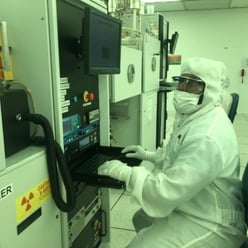
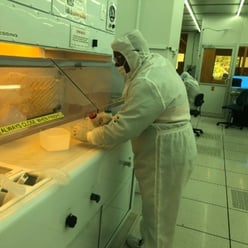
The Materials/Optics Research & Engineering (MORE) Lab provides students with the opportunity to participate in cutting-edge research at the intersection of physics, engineering, and quantum technology. Students in the lab work alongside faculty and collaborators on real research problems involving photonics, advanced materials, ultrafast optics, and quantum science.
Members of the MORE Lab gain hands-on experience with the tools and methods used in modern scientific research while developing critical thinking, technical skills, and professional confidence.
Students in the MORE Lab have opportunities to:
• Participate in active research projects in optics, photonics, and advanced materials
• Develop skills in scientific computing, modeling, and experimental design
• Present research at national conferences and academic symposia
• Collaborate with researchers from national laboratories, universities, and industry partners
• Contribute to publications, presentations, and innovative research initiatives
• Prepare for graduate school and careers in physics, engineering, and emerging quantum technologies
Through mentorship, collaboration, and discovery, the MORE Lab fosters a research environment where students can grow as scientists, innovators, and leaders.
Interested in joining the MORE Lab?
We welcome motivated students who are curious about science, excited about discovery, and eager to contribute to the future of quantum science and photonic technologies.
-
Research Projects
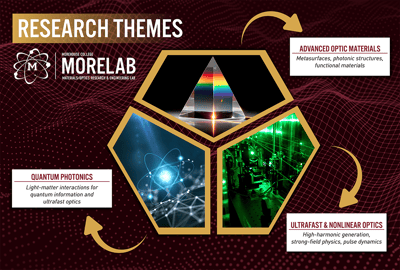
The MORE Lab conducts research at the intersection of photonics, quantum materials, and ultrafast light–matter interactions. Our projects explore new approaches to understanding and controlling quantum phenomena in advanced materials while developing next-generation optical technologies.
Through interdisciplinary collaborations with universities, national laboratories, and industry partners, the lab combines theoretical modeling, experimental design, and computational simulations to advance the frontiers of quantum information science and photonics.
Project Name: Multiscale Evaluations of Quantum Materials for Quantum InformationIBM-HBCU Quantum Center Initiative
This project investigates strategies for achieving coherent quantum optical control of technologically relevant quantum materials. The research focuses on understanding how light can probe and manipulate the electronic and optical properties of materials such as graphene and other correlated quantum systems.
The project explores photon-photon correlation architectures capable of detecting ultrafast quantum interactions with extremely high sensitivity, enabling the study of coherent and incoherent excitation mechanisms across a wide range of materials systems.
Research focus
- Quantum optical control of nanoscale materials
- Photon-photon correlation measurement techniques
- Modeling and simulation of quantum material systems
- Development of new ultrafast diagnostic tools for quantum dynamics
Collaborators
Morehouse College • Howard University • SLAC National Accelerator Laboratory
Project Name: Coherent Quantum Control and Quantum Electrodynamics
IBM/SPIE Faculty Accelerator Award
This project studies ultrafast electronic dynamics in quantum materials, particularly processes that occur on femtosecond and attosecond timescales.
The research centers on capturing high-harmonic generation (HHG) phenomena in real time, allowing researchers to observe electron motion and excitation processes in quantum materials with unprecedented temporal resolution.
To achieve this, the MORE Lab is developing new optical measurement architectures that can detect and analyze hyperspectral particle wave packets at attosecond-scale precision.
Research focus
- High-harmonic generation in quantum materials
- Attosecond-scale ultrafast optical dynamics
- Hyperspectral wave-packet correlation measurements
- Photonic architectures for quantum sensing
Collaborators
Morehouse College • UCLA • SLAC National Accelerator Laboratory
Project Name: Quantum Materials Temporal Analysis and Coherent Control using Attometrology for Quantum Information Science
NSF Expand-QISE Program
This NSF-funded project investigates ultrafast quantum interactions and decoherence mechanisms in advanced materials, particularly metamaterials and correlated quantum systems.
The project aims to develop a new experimental technique capable of detecting and cross-correlating particle and photon wave packets with attosecond precision. This technique enables the study of coherent and incoherent excitation processes critical to the development of future quantum technologies.
The research integrates theoretical modeling, materials characterization, and optical instrumentation development.
Research focus
- Ultrafast light–matter interactions in metamaterials
- Attosecond-scale optical metrology
- Balanced optical cross-correlation instrumentation
- Quantum coherence and decoherence mechanisms
Collaborators
Morehouse College • University of California, Los Angeles
Project Name: Reaching an Advanced Computing Technologies Workforce through Education Initiatives in Quantum Information Science and Engineering (ReACT-QISE)
DOE ASCR – RENEW (ReACT-QISE)
The ReACT-QISE initiative focuses on building the next generation of scientists and engineers trained in quantum information science and advanced computing technologies.
Through a national collaboration involving multiple universities, the program provides students with research opportunities in quantum optics, quantum sensing, and photonic technologies while preparing them for careers in the rapidly growing quantum technology workforce.
Students participate in research projects, summer internships, and collaborative training experiences across partner institutions.
Partner Institutions
University of Illinois Chicago • Morehouse College • Spelman College • Arizona State University • Tulane University • Southern University • Rensselaer Polytechnic Institute
-
Summer Programs
INITIATIVES & PROGRAMS
 Description: The More-QuEST Summer Program (Morehouse Quantum Engineering Science and Technology) is a STEM enrichment and research exposure initiative designed for high school students interested in science, engineering, and emerging technologies. The program introduces participants to foundational ideas in quantum science, optics, photonics, and advanced computing technologies while strengthening critical skills in scientific reasoning, problem solving, and technical communication.
Eligibility:
• Rising 9th–12th grade high school students
• Students with interest in science, engineering, or mathematics
• Participants must attend the program for the full program duration
Coming Soon
MORE-QuEST Summer Program - Application -
Student Opportunities
Research Assistant Roles
The MORE Lab welcomes motivated undergraduate students interested in research in optics, photonics, quantum science, and advanced materials.
Students involved in the lab participate in active research projects, develop technical skills in experimental and computational methods, and have opportunities to present their work at conferences and contribute to publications.How to Apply
Students interested in joining the MORE Lab can apply through one of the following pathways:

Direct Inquiry
Students may also contact:
Dr. Wesley Sims
Director, Materials / Optics Research & Engineering Lab
Morehouse College
Email: wesley.sims@morehouse.eduInclude the following:
- Major and class year
- Resume or CV
- Brief statement of research interests
-
Contact & Location
More Lab is a part of the STEM Division: Department of Physics. We are located in Dansby Hall, Room 105.

Need additional information?
Complete the form below.
Building Leaders in Physics
The Materials/Optics Research & Engineering (MORE) Lab provides students with the opportunity to participate in cutting-edge research at the intersection of physics, engineering, and quantum technology. Students in the lab work alongside faculty and collaborators on real research problems involving photonics, advanced materials, ultrafast optics, and quantum science.
Members of the MORE Lab gain hands-on experience with the tools and methods used in modern scientific research while developing critical thinking, technical skills, and professional confidence.
Students in the MORE Lab have opportunities to:
• Participate in active research projects in optics, photonics, and advanced materials
• Develop skills in scientific computing, modeling, and experimental design
• Present research at national conferences and academic symposia
• Collaborate with researchers from national laboratories, universities, and industry partners
• Contribute to publications, presentations, and innovative research initiatives
• Prepare for graduate school and careers in physics, engineering, and emerging quantum technologies
Through mentorship, collaboration, and discovery, the MORE Lab fosters a research environment where students can grow as scientists, innovators, and leaders.
Interested in joining the MORE Lab?
We welcome motivated students who are curious about science, excited about discovery, and eager to contribute to the future of quantum science and photonic technologies.
The MORE Lab conducts research at the intersection of photonics, quantum materials, and ultrafast light–matter interactions. Our projects explore new approaches to understanding and controlling quantum phenomena in advanced materials while developing next-generation optical technologies.
Through interdisciplinary collaborations with universities, national laboratories, and industry partners, the lab combines theoretical modeling, experimental design, and computational simulations to advance the frontiers of quantum information science and photonics.
Project Name: Multiscale Evaluations of Quantum Materials for Quantum Information
IBM-HBCU Quantum Center Initiative
This project investigates strategies for achieving coherent quantum optical control of technologically relevant quantum materials. The research focuses on understanding how light can probe and manipulate the electronic and optical properties of materials such as graphene and other correlated quantum systems.
The project explores photon-photon correlation architectures capable of detecting ultrafast quantum interactions with extremely high sensitivity, enabling the study of coherent and incoherent excitation mechanisms across a wide range of materials systems.
Research focus
- Quantum optical control of nanoscale materials
- Photon-photon correlation measurement techniques
- Modeling and simulation of quantum material systems
- Development of new ultrafast diagnostic tools for quantum dynamics
Collaborators
Morehouse College • Howard University • SLAC National Accelerator Laboratory
Project Name: Coherent Quantum Control and Quantum Electrodynamics
IBM/SPIE Faculty Accelerator Award
This project studies ultrafast electronic dynamics in quantum materials, particularly processes that occur on femtosecond and attosecond timescales.
The research centers on capturing high-harmonic generation (HHG) phenomena in real time, allowing researchers to observe electron motion and excitation processes in quantum materials with unprecedented temporal resolution.
To achieve this, the MORE Lab is developing new optical measurement architectures that can detect and analyze hyperspectral particle wave packets at attosecond-scale precision.
Research focus
- High-harmonic generation in quantum materials
- Attosecond-scale ultrafast optical dynamics
- Hyperspectral wave-packet correlation measurements
- Photonic architectures for quantum sensing
Collaborators
Morehouse College • UCLA • SLAC National Accelerator Laboratory
Project Name: Quantum Materials Temporal Analysis and Coherent Control using Attometrology for Quantum Information Science
NSF Expand-QISE Program
This NSF-funded project investigates ultrafast quantum interactions and decoherence mechanisms in advanced materials, particularly metamaterials and correlated quantum systems.
The project aims to develop a new experimental technique capable of detecting and cross-correlating particle and photon wave packets with attosecond precision. This technique enables the study of coherent and incoherent excitation processes critical to the development of future quantum technologies.
The research integrates theoretical modeling, materials characterization, and optical instrumentation development.
Research focus
- Ultrafast light–matter interactions in metamaterials
- Attosecond-scale optical metrology
- Balanced optical cross-correlation instrumentation
- Quantum coherence and decoherence mechanisms
Collaborators
Morehouse College • University of California, Los Angeles
Project Name: Reaching an Advanced Computing Technologies Workforce through Education Initiatives in Quantum Information Science and Engineering (ReACT-QISE)
DOE ASCR – RENEW (ReACT-QISE)
The ReACT-QISE initiative focuses on building the next generation of scientists and engineers trained in quantum information science and advanced computing technologies.
Through a national collaboration involving multiple universities, the program provides students with research opportunities in quantum optics, quantum sensing, and photonic technologies while preparing them for careers in the rapidly growing quantum technology workforce.
Students participate in research projects, summer internships, and collaborative training experiences across partner institutions.
Partner Institutions
University of Illinois Chicago • Morehouse College • Spelman College • Arizona State University • Tulane University • Southern University • Rensselaer Polytechnic Institute
INITIATIVES & PROGRAMS
Description: The More-QuEST Summer Program (Morehouse Quantum Engineering Science and Technology) is a STEM enrichment and research exposure initiative designed for high school students interested in science, engineering, and emerging technologies. The program introduces participants to foundational ideas in quantum science, optics, photonics, and advanced computing technologies while strengthening critical skills in scientific reasoning, problem solving, and technical communication.
Eligibility:
• Rising 9th–12th grade high school students
• Students with interest in science, engineering, or mathematics
• Participants must attend the program for the full program duration
Coming Soon
MORE-QuEST Summer Program - ApplicationResearch Assistant Roles
The MORE Lab welcomes motivated undergraduate students interested in research in optics, photonics, quantum science, and advanced materials.
Students involved in the lab participate in active research projects, develop technical skills in experimental and computational methods, and have opportunities to present their work at conferences and contribute to publications.
How to Apply
Students interested in joining the MORE Lab can apply through one of the following pathways:
Direct Inquiry
Students may also contact:
Dr. Wesley Sims
Director, Materials / Optics Research & Engineering Lab
Morehouse College
Email: wesley.sims@morehouse.edu
Include the following:
- Major and class year
- Resume or CV
- Brief statement of research interests
More Lab is a part of the STEM Division: Department of Physics. We are located in Dansby Hall, Room 105.
Need additional information?
Complete the form below.

Leadership
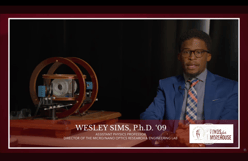
Dr. Wesley Sims is an assistant professor in applied physics at Morehouse College with an interest in strengthening optics and materials science, combining interdisciplinary training in physics, engineering and biomedical research.
Learn More About Dr. Sims
More Lab Sponsors

IBM-HBCU Quantum Center
- Morehouse College, Howard University, UCLA
- Agency: IBM-HBCU Quantum Center Initiative

IBM/SPIE – 2022 Faculty Accelerator Awardee
- Morehouse College, UCLA
- Agency: IBM/SPIE – International Society of Optics & Photonics
NSF Expand Quantum Information Science & Engineering
(Expand-QISE)
(Expand-QISE)
- Morehouse College, UCLA
- Agency: National Science Foundation (NSF)
DOE ASCR – Renew Reaching a New Energy Sciences Workforce
(ASCR-RENEW)
(ASCR-RENEW)
- UIC, Morehouse, Spelman, Tulane, Southern, ASU, RPI
- Agency: DOE-ASCR (Dept of Energy - Advanced Scientific Computing Research)